

The roof over your head is arguably the ultimate unsung hero of your home’s structural ecosystem. Day in and day out, it quietly and relentlessly shields your family, your electronics, your furniture, and your priceless memories from the harsh realities of nature. It bears the brunt of blistering summer ultraviolet rays, torrential spring downpours, high winter winds, and heavy accumulations of ice and snow. Because this vital shield operates entirely out of sight, it is dangerously easy for homeowners to adopt an out-of-sight, out-of-mind attitude toward its maintenance.
Unfortunately, total neglect is a strategy that always backfires in the home improvement world. A premature roof failure is a catastrophic financial hit that can instantly drain your savings, while an undetected leak can quietly rot out your wooden structural framing, ruin your ceiling insulation, and foster the rapid growth of toxic black mold inside your living spaces. Maximizing the operational lifespan of your existing roof system is not a matter of luck or waiting to see what happens after a heavy storm. It is the direct consequence of establishing a proactive maintenance rhythm, paying close attention to environmental threats, and coordinating smart, timely interventions. By taking active stewardship of your home’s primary shield today, you can easily add a decade of reliable service to its life, protect your family budget, and preserve your property’s long-term equity.
1. Establishing a Rigorous Biannual Walk-Around Inspection
Many homeowners believe that the only time to think about their roof is immediately after a historic hailstorm or when water is actively dripping into their living room. In reality, the best time to extend your roof’s life is during periods of calm weather when you can catch minor issues before they transform into costly structural emergencies. Establishing a strict biannual inspection schedule—ideally once in the early spring to check for winter damage and once in the late autumn to prepare for freezing weather—is the foundation of smart home ownership.
A thorough assessment actually begins on the ground and inside your attic, rather than on a dangerous ladder. You can use a high-powered pair of binoculars from the safety of your lawn to closely scan the roof slopes for displaced shingles, curling edges, or patches where the protective mineral granules have completely worn away. Following the exterior visual scan, grab a flashlight and climb into your attic space on a rainy day. Look closely along the rafters and the underside of the wooden roof decking for dark water stains, white efflorescence salt tracks, or rusted nails, which are clear indicators that water is finding its way past your outer shingles.
If your ground-level or attic search reveals suspicious anomalies, or if your property features steep, complex pitches that are impossible to view clearly, it is time to bring in professional support. Vetting and hiring a certified roofing contractor ensures that you receive a deep, safety-compliant, and warranty-compliant inspection of your entire system. These experienced professionals possess the specialized safety harnesses and training required to walk your roof lines safely, checking the structural integrity of tricky transition areas that standard homeowners easily miss. Relying on specialized local roofers is incredibly advantageous because these hometown tradespeople fully understand the specific wind, humidity, and storm-damage patterns common to your zip code, enabling them to recommend precise preventive measures tailored to your regional climate.
2. Managing Minor Moisture Penetrations Instantly
Water is an unforgiving force of nature. It requires only the microscopic breach in an old rubber boot or a single cracked shingle to initiate a slow, destructive journey into your home. A tiny, undetected water pathway can silently oversaturate your wooden roof deck week after week, compromising the structural strength of your home’s framing and destroying your interior drywall long before a visible drop ever lands on your flooring.
One of the most challenging aspects of moisture management is the complex science of tracking a water breach. Because gravity forces water to follow the path of least resistance, the location where a water spot forms on your bedroom ceiling is rarely directly underneath the actual hole on your exterior roof. Water will frequently enter through a breach near the ridge, run down the sloped face of a rafter for ten or fifteen feet, and finally drop onto your drywall where a seam or light fixture creates an opening. Finding and sealing these entry routes requires patience, specialized tools, and immediate action.
When dealing with moisture breaches, homeowners must keep a close eye on the most vulnerable areas of the roof layout:
- Penetration Flashing: The sheet-metal collars installed around high-risk openings, such as chimneys, skylights, dormer walls, and plumbing exhaust stacks, are highly susceptible to shifting and rust.
- Roof Valley Seals: The low points where two intersecting roof slopes meet channel thousands of gallons of rushing rainwater during a storm, making any minor gap an immediate highway for water.
- Degraded Pipe Boots: The rubber seals that surround plastic plumbing vents frequently crack and dry out under constant sun exposure long before the surrounding shingles fail.
The moment you detect a breach, you must secure targeted local roof repair to mechanically cut out and replace the compromised elements before the damage spreads across your entire ceiling. Attempting a quick, temporary fix by smearing a tub of cheap roofing cement over a suspected crack is a mistake; these caulking compounds expand and contract at different rates than shingles, rapidly cracking open and trapping moisture underneath. A professional solution fixes the root cause of an active roof leak, swapping out torn underlayment and installing fresh flashing to maintain a completely watertight barrier across your home.
3. Clearing Environmental Debris and Biological Growths Safely
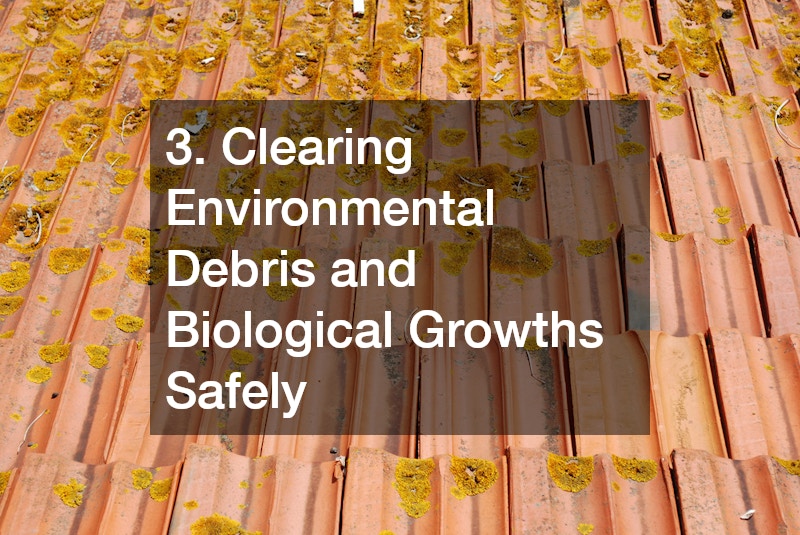
Your roof is constantly subjected to a heavy barrage of organic matter, especially if your property is nestled beneath a mature canopy of shade trees. Leaves, pine needles, twigs, and seed pods gather in heavy blankets within roof valleys and directly behind chimneys, trapping dampness against the shingles. When organic debris sits undisturbed on an asphalt surface, it forms a damp, acidic mat that slowly rots away the protective shingle coatings, accelerating structural decay.
Beyond simple leaf accumulations, roofs are highly vulnerable to destructive biological infestations like moss, lichen, and algae. Blue-green algae is the primary culprit behind those ugly, dark black streaks that form on northern roof slopes; this organism actively feeds on the limestone fillers used in modern asphalt shingle manufacturing, stripping away the roof’s natural UV reflectivity and causing the home to absorb excessive summer heat. Even worse is the growth of structural moss and lichen. These organisms feature tenacious, root-like structures that anchor deep into the asphalt mat, physically prying the shingles upward and creating open pockets that allow wind-driven rain to blow straight into your home.
Erasing these biological threats requires a delicate, highly specific cleaning methodology. Many well-meaning homeowners make the devastating mistake of renting a heavy-duty power washer and blasting the green growth away with high-pressure water. This aggressive blasting is incredibly destructive, shearing off millions of the protective mineral granules that shield the asphalt from the sun, instantly aging your roof structure by an entire decade.
To clean your architectural surfaces safely without stripping away their protective layers, you should carefully research the cleaning methodologies used by modern roofing companies. Safe maintenance requires hiring specialized, low-pressure roof washing services that utilize eco-friendly, chemical soft-wash solutions. These targeted chemical washes are gently sprayed onto the roof surface to neutralize and dissolve algae, moss, and lichen down to the root level without disturbing the shingle granules. Once the biological growth is safely eradicated, installing zinc or copper strips along the roof ridge provides a permanent preventative defense, as rainwater will slowly wash zinc ions down the slopes during every storm, naturally inhibiting future organic growth for years to come.
4. Preserving Specialty Natural Architectural Overlays

While standard asphalt three-tab and architectural shingles dominate the modern suburban landscape, many premium homes feature traditional, natural fiber roofing materials like split wood shakes. These specialty natural wood overlays offer an unmatched, historic aesthetic and incredible natural insulation values, but they demand a completely different maintenance philosophy than synthetic or stone-based materials.
Natural wood roof systems are organic, meaning they must be allowed to breathe, dry out uniformly, and expand and contract naturally with changing humidity levels. If a wood roof is subjected to chronic dampness, it will rapidly fall victim to wood-boring insects, deep rot, and structural splitting. The absolute primary rule of wood shake maintenance is ensuring total exposure to moving air and natural sunlight. Overhanging tree branches must be aggressively trimmed back at least ten feet away from the roofline to prevent constant shade and stop wet leaves from falling directly onto the delicate wood shakes.
Preserving a premium wood fiber roof requires a master artisan who possesses deep material knowledge far beyond basic modern shingle installations. You must seek out an expert roofer who can accurately assess the oil retention, moisture levels, and structural soundness of every single shake. Working alongside a dedicated cedar shake residential roofer ensures that when a piece splits or warps due to sun exposure, it is carefully pulled out using a specialized shingle ripper without disturbing the surrounding interlaid felt layers. A fresh, matching shake is then slid into position and secured with stainless steel or copper fasteners, keeping the natural overlay completely uniform, beautifully balanced, and fully capable of shedding heavy rains for decades.
5. Optimizing Attic Ventilation and Eaves Drainage Control

A roof’s longevity is heavily dictated by what is happening directly underneath it within your attic space. A roof system must be viewed as a dynamic, breathing envelope. If your attic lacks proper ventilation, your roof will effectively be baked alive from the inside out during the hot summer months. Trapped, superheated attic air can easily reach temperatures exceeding one hundred and forty degrees, melting the underlying shingle adhesives, blistering the asphalt mats, and causing your shingles to become incredibly brittle and prone to cracking under light wind loads.
In the winter, poor ventilation creates an entirely different structural disaster known as an ice dam. When warm air escapes from your living spaces into an unventilated attic, it heats up the upper sections of the exterior roof deck, causing the accumulated snow cover to melt. This meltwater runs down the sloped roof until it reaches the eaves, which overhang the exterior walls and remain at a freezing temperature. The water instantly refreezes at the cold edge, forming a heavy wall of ice that forces subsequent meltwater to pool up behind it. This standing water quickly backs up underneath your shingles, bypassing your primary barriers and leaking straight into your exterior wall cavities.
- Intake and Exhaust Balance: Ensure your attic features an equal balance between lower intake soffit vents to draw in cool air and continuous upper ridge vents to allow hot, humid air to escape naturally.
- Baffle Installation: Verify that your insulation blankets are not blocking your soffit openings; install plastic attic baffles to guarantee a clear channel for moving air.
- Gutter Clearance: Keep your gutter pathways completely clear of seasonal debris and leaves to ensure heavy stormwater can instantly exit away from the roof edge rather than backing up under the fascia boards.
Expanding your home maintenance strategy to include these complete diagnostic checks through professional residential roofing services ensures that your entire attic envelope remains in perfect balance. Investing resources into optimizing your home’s airflow, air sealing, and eave drainage today allows you to delay a massive, premature multi-thousand-dollar roof replacement for an additional ten or fifteen years, guaranteeing that your home’s primary shield remains strong, durable, and fully operational through every seasonal extreme.
Conclusion
Maximizing the operational lifespan of your home’s roof is a masterclass in proactive property management and deliberate home maintenance. Your roof is a dynamic, highly engineered system that requires consistent, active stewardship rather than total neglect. It is your home’s primary line of defense against the elements, and its health directly impacts the safety, financial value, and structural integrity of your entire property.
By committing to a regular schedule of biannual inspections, managing minor moisture leaks the moment they appear, utilizing gentle low-pressure washing services to eliminate biological growth, and maintaining a perfectly balanced attic ventilation system, you completely remove the risks that cause early roof failure. True property protection is the result of catching small vulnerabilities before they have a chance to turn into midnight emergencies. When you invest the time, effort, and care required to insulate your shingles from environmental extremes and organic rot, you ensure that your primary shield remains sturdy, secure, and fully capable of protecting your family for decades to come.